

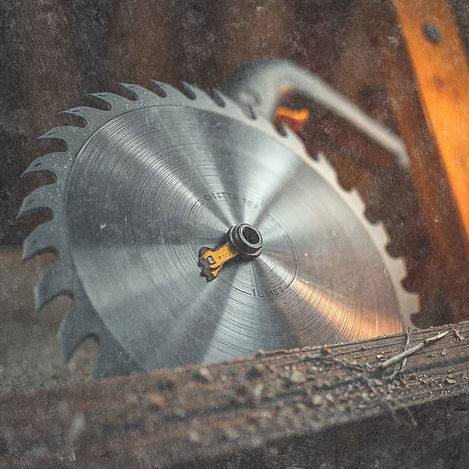
Industrial Circular
Saw Blades
Engineered edges for rip, crosscut, panel, and everything in between, led by Hill Country Tool, our best-selling line, and the blades wood-processing shops, cabinet makers, and industrial operations choose when they can't afford an inconsistent cut.
Every blade we carry is organized by application, the same way our own techs think about the job: what are you cutting, and what result do you need?
Blades by Application
The everyday workhorse: rip, crosscut, and mixed-material cutting in one blade. A 10° alternate-top-bevel grind keeps the edge clean on both solid wood and manufactured panels, so the saw keeps running without blade swaps.

Flat-top ripping blades with low tooth counts and deep gullets for breaking rough lumber down to width: and glue joint blades that leave an edge clean and square enough to go straight from the saw into the clamps. No jointer pass, no sanding.

Combination:
For the shop that rips and crosscuts on the same machine. Teeth run in groups of four alternating-bevel teeth plus a flat raker, with a deep gullet to carry chips; one setup, all day.

Built for cutting across the grain to a finished length; the last cut before a part goes into an assembly, where a chipped edge means the piece gets thrown away. High tooth counts, fine finish grinds, and negative-hook blades for slide and portable miter saws.

Corian, Wilsonart, Staron and the rest of the acrylic and polyester solid-surface family cut clean only when the tooth breaks the chip instead of tearing it. Triple chip grinds built exactly for that.

Melamine & Laminate:
Coated panel chips on the way in and on the way out. High alternating top bevel puts a fine scoring point at both faces of the cut, and negative hook keeps the blade from climbing into the panel.

Aluminum and non-ferrous blades, truss and component saws, panel and scoring sets, and the finish and trim blades customers ask for by name.

How to Choose Your Blade
Three questions settle almost every blade order: what are you cutting, which way is the grain running, and what does the finished edge have to look like? Match the answer to a grind.
An ATB (alternate top bevel) grind shears the wood fiber from alternating sides, which is what gives a blade a clean edge on both rip and crosscut work; the right answer for general shop work, crosscutting, and plywood. HATB (high alternate top bevel) sharpens that point further for melamine, laminate, and coated panel, where the surface chips if the tooth doesn't score it first. A triple chip grind alternates a chamfered tooth with a flat raker; the chamfered tooth roughs the center of the kerf, the flat tooth cleans the corners, which is why it's the grind for solid surface, non-ferrous metal, and abrasive stock.
Flat top grinds plough straight through the fiber, the fastest and most durable way to rip with the grain. And a combination grind puts rip and crosscut in one blade for the shop where swapping blades costs more time than the compromise does.
Hook angle matters too. A positive hook leans into the cut and pulls the blade forward; excellent on a table saw, dangerous on a chop or sliding miter saw, where it makes the blade climb and grab the workpiece.
That's why our portable miter blades run a negative 5° hook: it costs a little feed speed and buys back control and a cleaner exit.
Still not sure? Tell your rep the material, the machine, and the finish you need, and we'll pick the grind. That's the part we actually know, and it costs you nothing.
The Brands We Stand Behind






The Frank's Difference
No pricing shown; tell us the machine, the material, and the finish, and we'll tell you the tool.
On our routes? Your rep carries this line on the truck.